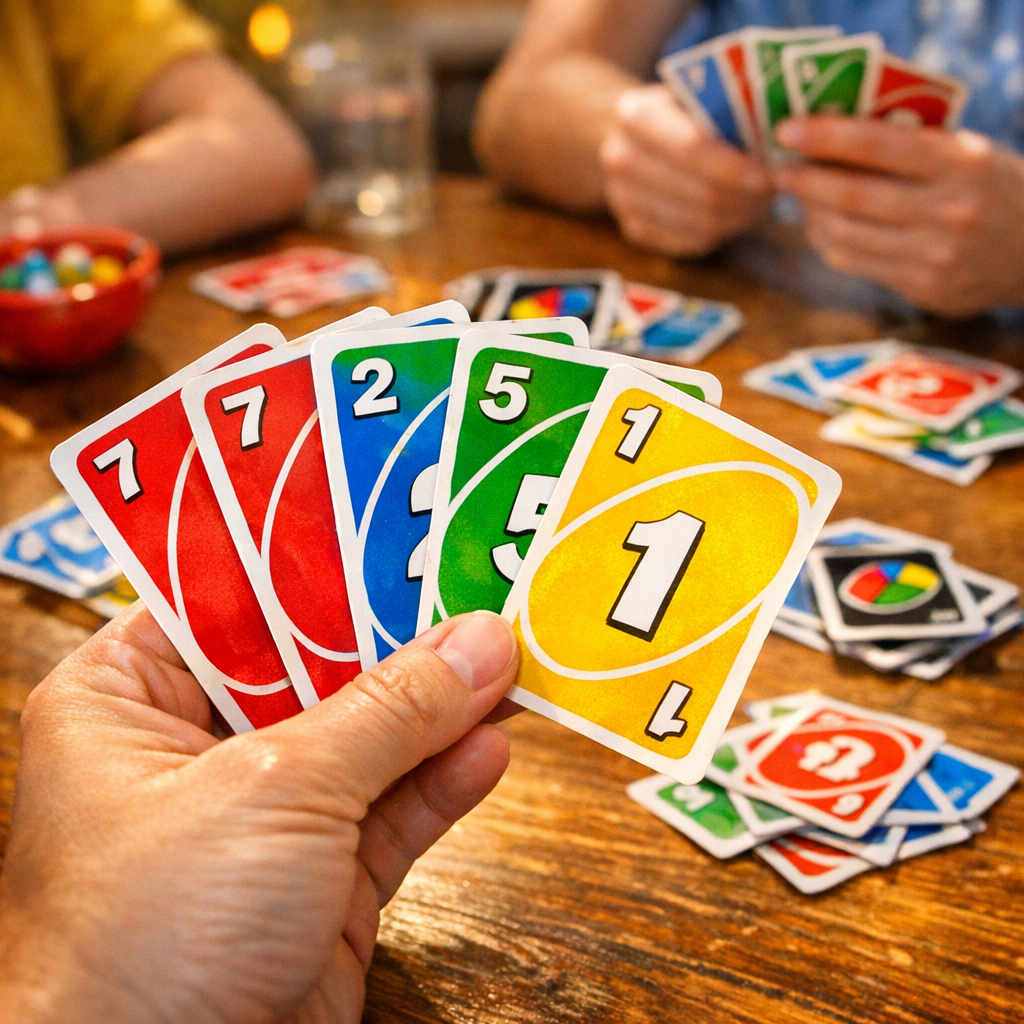
UNO needs no introduction. It's been destroying friendships and creating memories since 1971. Over 150 million copies sold. Played in virtually every country. And yes, your family probably has at least one deck somewhere. But is it actually good? Let's talk.
What Is UNO?
In case you've somehow never played: UNO is a card game where players take turns matching cards by color or number to a central discard pile. Special cards let you skip opponents, reverse play direction, or force the next player to draw cards. First player to empty their hand wins — but only if they remember to yell "UNO!" when they're down to one card.
The rules are simple. The chaos is not.
The Family Reality
Let me be honest: UNO is not a "good" game by modern board game standards. It's almost entirely luck-based. You can play perfectly and still lose because someone dropped four Draw Twos on you in a row. Strategy is minimal.
And yet... we play it constantly.
"Draw Four. Draw Four again. Oh, and I'm going out. UNO! I WIN!" — My 6-year-old, drunk with power
Here's the thing: UNO isn't about winning or strategy. It's about the shared experience. The groans when someone plays a Draw Four. The cheers when you successfully stack cards. The accusations of cheating (always unfounded, I swear). The betrayal when your own child reverses just to hit you with a Skip.
For families, especially those with younger kids, UNO delivers something valuable: a game everyone can play on equal footing. My 6-year-old beats my 14-year-old regularly. That's not true of almost any other game we own.
The Good Stuff
- Universal accessibility: Anyone who can match colors can play
- Great equalizer: Luck means kids genuinely beat adults
- Portable: A deck fits anywhere
- Quick games: 15-30 minutes (usually)
- Cheap: Under $10 for the base game
- Everyone knows it: No rules explanation needed at most gatherings
The Not-So-Good Stuff
- Pure luck: Minimal strategic decisions
- Can drag: Games sometimes last way too long when no one can go out
- Can feel mean: Getting hit with multiple Draw cards isn't fun
- House rule confusion: Everyone plays with different rules (stacking, etc.)
- Kingmaking: Players can choose who to target with attack cards
Let's Talk House Rules
No two families play UNO the same way. Here are the most common house rules and our take on them:
- Stacking Draw Cards: Can you play a Draw Two on a Draw Two? Officially, NO. But most families allow it. We do too — it's more dramatic.
- Jump-In: If you have the exact same card, you can play it out of turn. Makes the game faster and more chaotic.
- 7-0 Rule: Playing a 7 lets you swap hands with someone; playing a 0 rotates all hands. Adds strategy but also chaos.
- Challenge Draw Four: Official rule that most people forget — you can challenge a Wild Draw Four if you think they had a playable card.
UNO Variants Worth Trying
- UNO Flip: Cards have two sides; a flip card reverses the deck to a harder side. Adds strategy.
- UNO Attack: Instead of drawing, you press a launcher that might shoot cards at you. Kids LOVE this.
- DOS: UNO's sequel where you match to two discard piles. More strategic but less chaotic.
The Verdict
Is UNO a great game? By modern design standards, no. Is it a great family experience? Absolutely.
UNO succeeds because it's simple, accessible, and creates genuine excitement around a table. It's the game that toddlers and grandparents can play together. It's the game you bring on vacation because everyone knows it. It's the game that's caused more fake outrage in our house than any other.
Don't expect strategy. Do expect fun. And maybe keep a spare deck handy — the cards get worn out fast.
Final Score: 7/10 — Not a great game, but a great family experience